Raphael Winckler de Bettio
For startups · Proofs of concept · Prototypes · MVPs

Your idea working
in weeks, not months.

I build proofs of concept, prototypes and MVPs for startups and companies that want to get an idea off the ground quickly: validate a hypothesis, test with users, win over investors and funding programs, or reach the market. You get a working system, with code, documentation and clarity on what has been proven.

Full Professor, Department of Applied Computing, UFLA
PhD in Knowledge Engineering and Management (UFSC)
MSc in Production Engineering (UFSC)
BSc in Computer Science (FURB)
15 years teaching programming at university
10+ years in the software industry
Registered software (INPI, Brazil)
Who it's for

Built for startups that need to get their idea off the ground

Every idea goes through three questions: does it work? How would it be used? Will anyone pay for it? Answering the right question at the right time is the cheapest path — before hiring a team, spending the investment, or promising what hasn't been tested yet.

Founders without a tech team

You know the problem and the market, but there is nobody to build it yet. I take the technical role in this phase: I turn the idea into something that works and leave everything ready for the team that comes next.

Startups raising investment

Something that actually works to show in a pitch, panel or funding round — instead of slides and promises.

Startups applying for grants

A proof of concept or prototype, plus the technical part of the proposal, for innovation funding programs, showing the technology readiness the call requires.

I also work with companies that want to test a new idea before investing in a large project.

Testimonials

What people say about my work

Technical conversation · Industry 4.0

“Sometimes a few hours with the right person can save weeks of development in the wrong direction.”

Raphael's support was important at a moment when we had to make technical decisions about hardware, sensors and communication protocols for an Industry 4.0 project.

Our team mastered software development, but we had important doubts about which architecture and communication standard would fit best. Raphael's experience helped us weigh the alternatives and decide with much more confidence.

Read the full testimonial

From that decision, we were able to design a more open, scalable solution with less vendor dependence, and gained much more clarity to estimate costs, development effort and the project's margin.

More than recommending a technology, the consulting helped us reduce uncertainty and turn a technical decision into a business decision.

Clodoaldo TschökeExecutive Director · Coden3 Tecnologia Ltda. · translated from Portuguese
LinkedIn

Context: a one-off technical conversation, at no cost — the same format as the first step offered here.
Proofs of concept · Research at UFLA

“…turn a still loosely defined need into a concrete solution that could be tested and evaluated.”

During my postdoc at UFLA, I worked on evaluating technologies that could be applied to demands related to forensic work for the Civil Police. At some point, I realized that, beyond research and conceptual evaluation of the technologies, it would be important to build proofs of concept to verify in practice how these solutions could work.

That is when I counted on Raphael's support. He helped me turn the ideas and requirements we had into two working proofs of concept, taking part in defining the technologies, the architecture of the solutions and the integration of the different components involved.

Read the full testimonial

The work was important because it allowed us to move beyond a mostly theoretical evaluation and try the solutions in practice. With the prototypes, we were able to better understand the possibilities, identify limitations and assess more confidently the viability of the technologies for the context in which they would be used.

Raphael's contribution was especially important because he was able to move across different areas of technology and turn a still loosely defined need into a concrete solution that could be tested and evaluated.

Tales Giuliano VieiraOfficial Forensic Expert, Minas Gerais Civil Police · translated from Portuguese
LinkedIn

Context: academic work at UFLA — I co-supervised Tales's postdoctoral research, and the proofs of concept were built as part of it.

How it works

Fixed scope, short cycles, no surprises

From day one you know what will be delivered, how long it takes, and what is out of scope.

First conversation

An initial technical conversation, at no cost, to understand the idea and see which stage — POC, prototype or MVP — makes sense now.

Written scope

The hypothesis to prove, what is in, what is out, timeline and price — all in a short document.

Demo-driven cycles

Every cycle you see something working and can adjust course early, not just at the end.

Delivery

Source code, documentation, run instructions and a presentation of the results.

Packages

Three stages, depending on the question you need answered

Each stage matches a level on the Technology Readiness Level (TRL) scale used by funding programs and investors. Timelines reflect my dedication of up to 8 hours per week; the exact scope is agreed after the first conversation.

First step

Start with a technical conversation

No commitment and no cost: you bring the idea or the technical question, and I give you a frank opinion on feasibility, risks, technologies and the best next step — which may be one of the packages below, or none of them. It is just a conversation: it does not include development, review of materials or any written deliverable.

See what a conversation like this has already solved →
Book a conversation

Prototype

8–12 weeks

Something presentable to investors, review panels and test users.

  • Clickable, deployed prototype
  • Interface designed for demos
  • Technology readiness document (TRL)
  • Technical roadmap to the product
  • Support with the technical part of grant applications
Price on request
I want a prototype

Minimum viable product (MVP)

12–20 weeks

A first version of the product, used by real customers.

  • Core features, prioritized with you
  • Product deployed and ready for the first customers
  • Usage data and customer feedback
  • Technical foundation ready to grow
  • Source code, documentation and handover to your team
Price on request
I want an MVP

Because I work part-time on consulting, I take on few projects at once, always with a fixed scope. Ongoing maintenance and operations are not included: the delivery is prepared so your team — or another team — can take it forward.

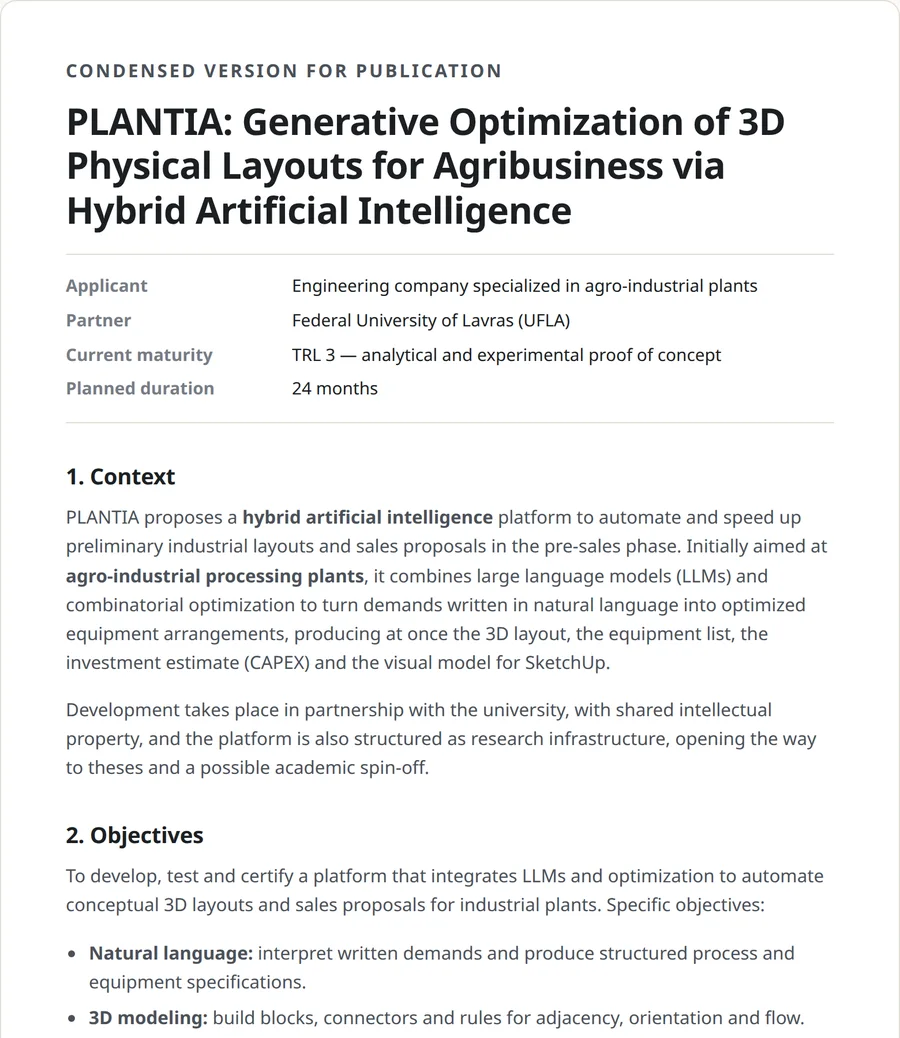
Deliverable example · condensed version

See what a project delivers

A real example, shown here in a condensed version: the PLANTIA proof of concept became a technical document ready to compete in a funding call — with the problem, the solution, evidence of what already works, the market comparison and the timeline. This is the kind of material that can come with the proof of concept and prototype packages.

  • Problem and goals explained for the reviewers
  • Proof-of-concept evidence, with images of the working system
  • What is still to be built, without hiding the limits
  • Market, innovation and timeline
First page of the example document
What kind of idea can be proven

You focus on the business; I take care of the technology

With multidisciplinary experience, I pick the right tools for each idea. A few kinds of products I have built:

AI-powered products

Assistants, automations and tools that use AI reliably, with every result checked.

Web platforms and apps

The product's main flow working, from sign-up to the user dashboard, to test with real customers.

Data and dashboards

Bringing scattered data together into indicators and dashboards that support decisions.

Maps and location

Products that depend on where things are: areas, routes, incidents and monitoring.

Devices and sensors

Prototypes with custom hardware to measure, monitor and automate.

Education and training

Learning platforms with personalized paths and automatic grading.

See examples in the portfolio →

Why me

Research rigor, industry practice

Speed without losing control

I use AI tools to speed up development, always with review, tests and deliberate architecture — the code you receive is yours and understandable.

Honesty about limits

A POC makes clear what has been proven and what hasn't yet. That is worth more to an investor than a demo that hides the gaps.

Documentation that helps you raise funds

I have co-written the technical sections of many research and innovation proposals submitted to funding agencies — I know how to present what was built and proven.

End-to-end experience

From concept to deployment: platforms used by thousands of people and projects with large companies and government agencies.

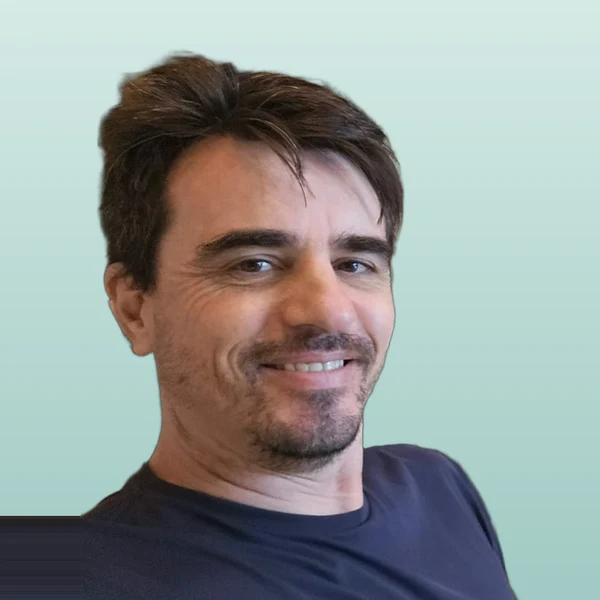
Photo of Raphael Winckler de Bettio
  • Full ProfessorDepartment of Applied Computing, Federal University of Lavras (UFLA), Brazil
  • PhD in Knowledge Engineering and ManagementFederal University of Santa Catarina (UFSC)
  • MSc in Production EngineeringFederal University of Santa Catarina (UFSC)
  • BSc in Computer ScienceRegional University of Blumenau (FURB)
About

Raphael Winckler de Bettio

I have been programming since my teens. Before joining the university, I spent over a decade in industry: ERP developer, e-learning researcher, co-founder of an award-winning corporate portal startup, technical lead on federal government projects, and consultant on mission-critical systems in São Paulo.

For 15 years I have taught at UFLA, always in programming-focused courses — algorithms, data structures, web and mobile development, distributed systems, among others. At the university I have also designed and built platforms used by thousands of people, served as technical lead on large innovation projects with companies and government, and registered software in areas such as educational technology, educational robotics, smart homes and accessibility.

I have always seen computing as a tool for solving real problems. Now I dedicate part of my time to helping people with a good idea find out — quickly and reliably — whether it works.

FAQ

Before we talk

I don't have a tech team. What happens after the POC?

You get the code, the documentation and a clear explanation of how to move forward. I can help define the profile of your first developer or assess a hired team for the next phase — so you don't depend on me.

Do you help with funding applications?

Yes. In the proof of concept and prototype packages, I can prepare the technical part of the proposal: context, feasibility backed by the POC evidence, technology readiness and timeline. See a condensed example of a technical document for a funding call.

Who owns the code and the intellectual property?

You do. The code developed for the project is delivered to you, and this is set out in the contract. Generic tools I already had before the project may be used as a foundation, without limiting your use.

How much does the first conversation cost?

The initial technical conversation has no cost and no commitment — it is just a conversation, with no development or deliverables. If it makes sense to move forward, the package scope and price are agreed afterwards, in writing.

Will my idea stay confidential?

Yes. I am happy to sign a non-disclosure agreement (NDA), even before you go into detail.

What is the difference between a POC, a prototype and an MVP?

A POC proves that the core mechanism works. A prototype shows how the solution would be used and is meant for presenting. An MVP is a minimal product running with real customers. I can take you through all three stages; after the MVP, ongoing development and operation are handled by your team or a hired team.

Why part-time?

I am a professor at UFLA under an exclusive-dedication contract. Brazil's Federal Teaching Career Law (Law 12,772/2012, art. 21) allows professors under this regime to engage in occasional collaboration with companies, in their field of expertise, for up to 8 hours per week and 416 hours per year. This was reinforced by Brazil's Legal Framework for Science, Technology and Innovation (Law 13,243/2016), created to bring universities and industry closer together.

That is why I work with a fixed scope and few projects at once — which also keeps the focus on each one.

Each project is authorized in advance by the university, under UFLA's Resolution CUNI 67/2021, so work starts a few weeks after we agree on the scope.

Do you work remotely?

Yes. All the work can be done remotely, for clients anywhere in Brazil or abroad, with online meetings for the demos.

What if the POC shows the idea doesn't work?

That is a result too — and usually the cheapest one you will ever get. The report explains why and, where they exist, the alternative paths.

Contact

Shall we talk about your idea?

Tell me in a few lines what you want to test. I reply personally.